

Patent transfer from ZESS to Albrecht Bäumer

The Universität Siegen of Siegen, through the Center for Sensor Systems (ZESS) and the chair of Prof. Dr. Peter Kraemer, has successfully transitioned a novel patent for real-time sensor monitoring to Albrecht Bäumer GmbH & Co. KG. Developed under the ZIM-funded “iKnife4Foam” project, this technology represents a significant leap in structural health monitoring for the foam processing industry.
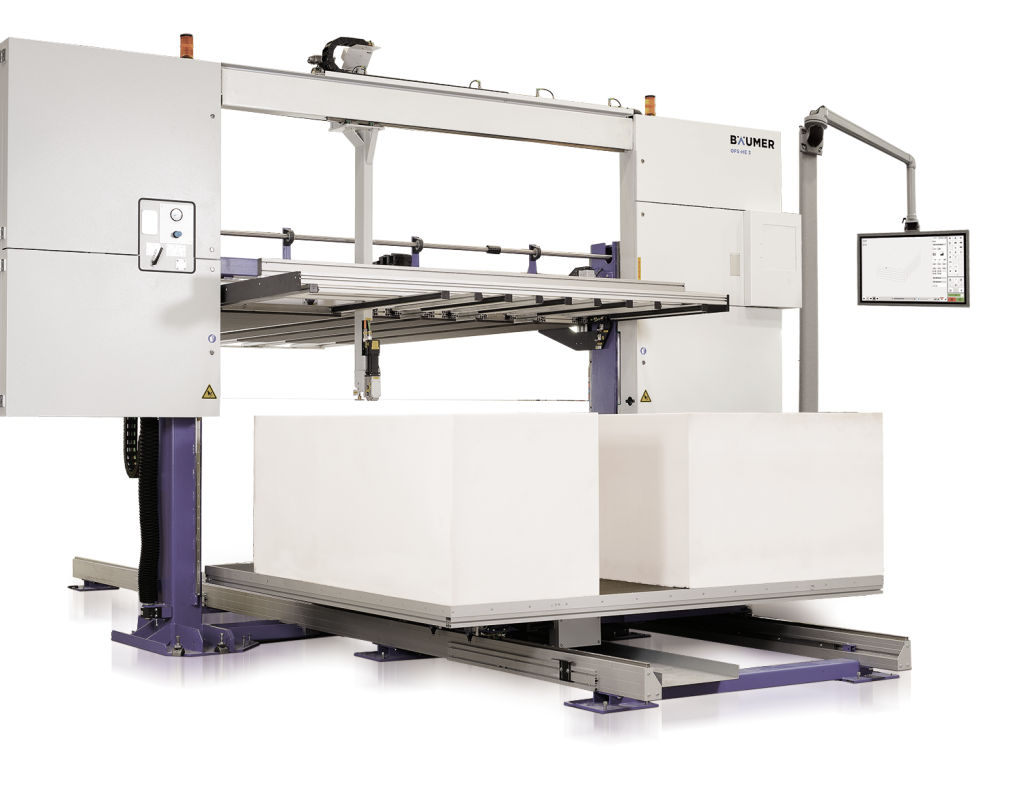
In foam processing, endless circulating band knives are subject to continuous mechanical stress, tensile loads, bending, and torsion, which ultimately lead to blade failure. The patented system integrates multiple sensor types directly into the cutting machine. It continuously captures signals indicative of blade degradation, enabling operators to act before a failure occurs and avoid unscheduled production downtime.
Under the guidance of Prof. Dr.-Ing. Peter Kraemer, researcher Shubham Sharma carried out sensor data collection across multiple blade life cycles, conducted failure analysis, performed numerical simulations, and developed data-driven prognostics models for estimating remaining useful life. Wolfgang Richter provided sensor instrumentation and hardware integration expertise that proved critical for dependable data capture in both laboratory and industrial environments.
The project’s success relied on close collaboration with Albrecht Bäumer GmbH & Co. KG, who supported the setup of test equipment for both laboratory and industrial testing and provided support at every step of the project. Namely the involvement of head of R&D and Product Innovation Philipp Bertelmann, R&D engineer Jannis Wittrock and Andreas Nollen kept the research grounded in real manufacturing needs from the start.
This transfer highlights the University’s commitment to the innovation2business.nrw framework, bridging the gap between fundamental sensor research and market-ready industrial applications. As Bäumer integrates this data-driven solution into its global portfolio, the project stands as a benchmark for successful academic-industrial synergy, enhancing both process efficiency and resource sustainability in modern manufacturing.
